Pushing Positions for Labor: Why the Hospital Bed Isn’t Your Only Option

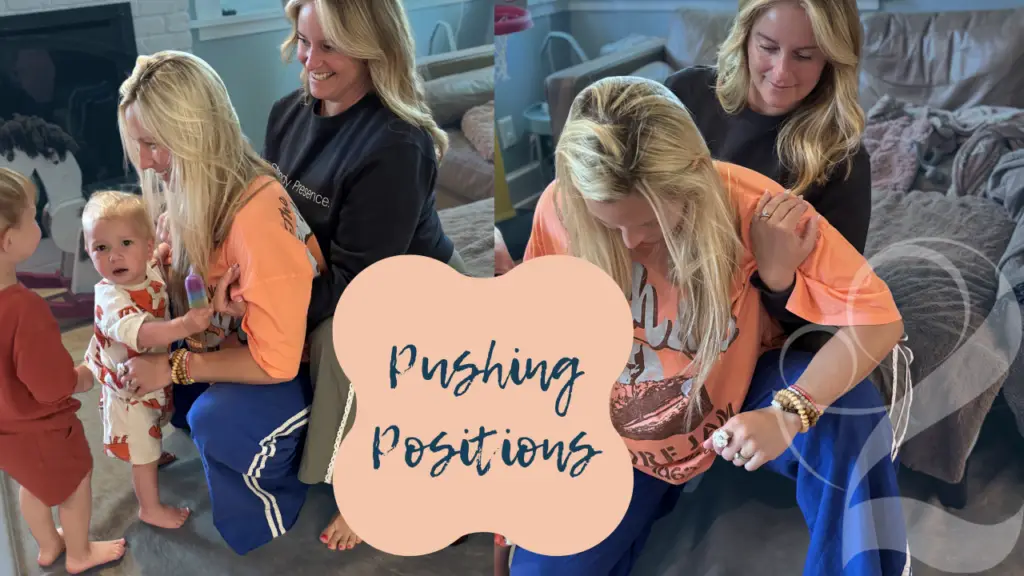
Pushing Positions for Labor

Most of us picture pushing the same way. Flat on our back. Feet up in stirrups. Someone counting to ten while we hold our breath. It’s the version Hollywood shows us, and for a long time, it’s been the version most hospital rooms have expected.

But here’s what we wish every mom knew before she walked into her birth. There are more pushing positions for labor than that one. A lot more. And the position you push in can actually change how labor feels, how effective each push is, and how your body works alongside gravity instead of against it.

In this post, we’re walking through the why behind pushing positions, the four options we use most often as doulas, what changes when you have an epidural, and how to know which position is working for your body in the moment.

Do Pushing Positions for Labor Actually Matter?

If you’ve ever felt like the pushing stage was something that just happens to you, you’re not alone. A lot of us go into birth assuming position is the part you don’t really get to choose.

What we’re seeing in birth, though, is that position matters more than most moms are told. There are three principles we lean on as doulas, and they come up in trainings like Spinning Babies and Body Ready Method.

  • Gravity. When you’re upright, gravity helps your baby move down. When you’re flat, gravity is working against you.
  •  Movement. A pelvis is a structure made of bones that can shift. Different positions open different parts of the pelvis at different times.
  • Balance. When the muscles and ligaments around the pelvis are relaxed, there is more room for baby to navigate down and out.

There is also research backing this up. A Cochrane review of 30 studies found that women who pushed in upright positions, compared with lying on their backs, had a shorter second stage of labor and fewer episiotomies. In other words, position is a tool. It’s one of the few tools that’s available to you in the middle of labor, no matter what else is happening.

How did Back-Lying Become the Default? (and What It Costs You)

So how did flat-on-your-back become the standard? Honestly, it wasn’t about what worked best for the laboring person. It was about what worked best for the provider.

When birth moved from homes to hospitals, providers needed a position where they could comfortably sit on a stool, see the perineum, and catch the baby. Lying on your back, legs in stirrups, was the most convenient option for the people delivering care.

It’s not a bad position because the people who use it are bad people. It’s just that this position does a few specific things to your body.

  • It presses your tailbone into the bed, which limits how much the sacrum can move out of the way as baby descends.
  • It removes gravity from the equation. Your baby now has to travel without that help.
  • It can narrow the pelvic outlet, especially when your legs are pulled back wide.

The good news is that even if you do end up on your back for any reason, there are small modifications that can help.

  • Tuck a rolled towel under one hip. This lifts one side of the pelvis and creates space for the tailbone.
  • Try closed knee pushing. With your knees pressed together and ankles apart, the sits bones move further apart, which opens the outlet.
  • Push your feet into something firm, like the bed rails or a support person’s hands, to get more leverage.

4 Pushing Positions for Labor to Know About

Here’s where we get practical. These are the four positions we work with most often as doulas. Not every position fits every body or every birth, and that’s the point. Having options matters. 

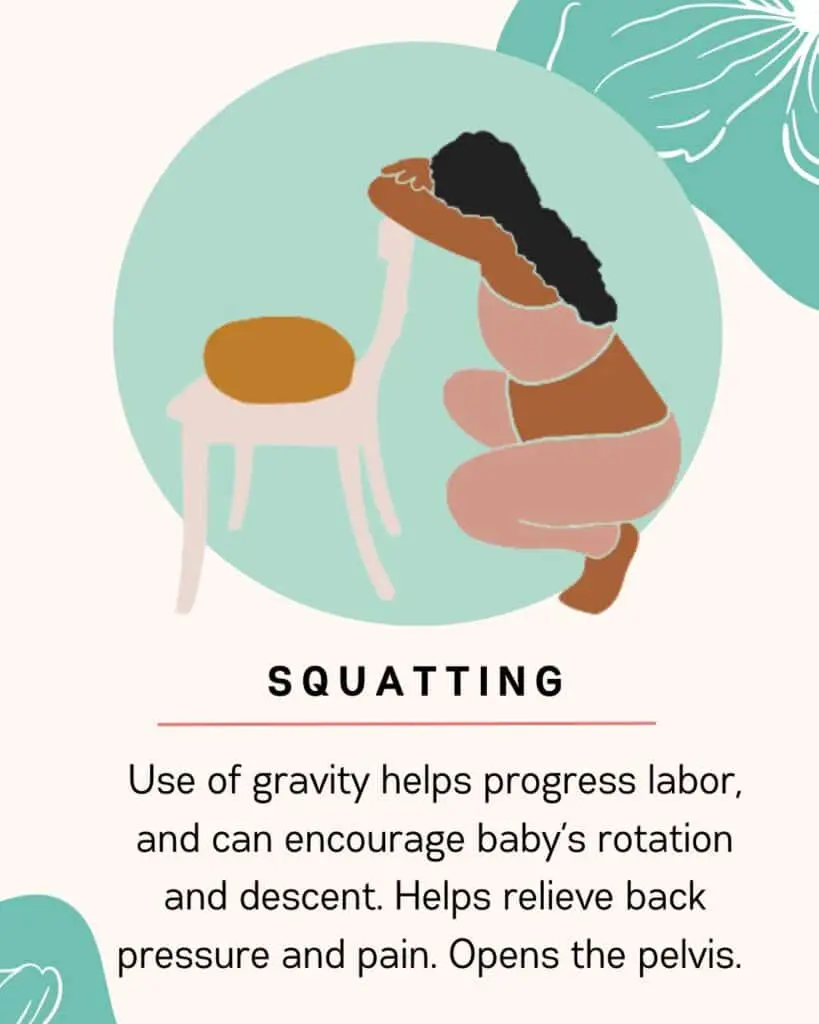
Squatting During Labor

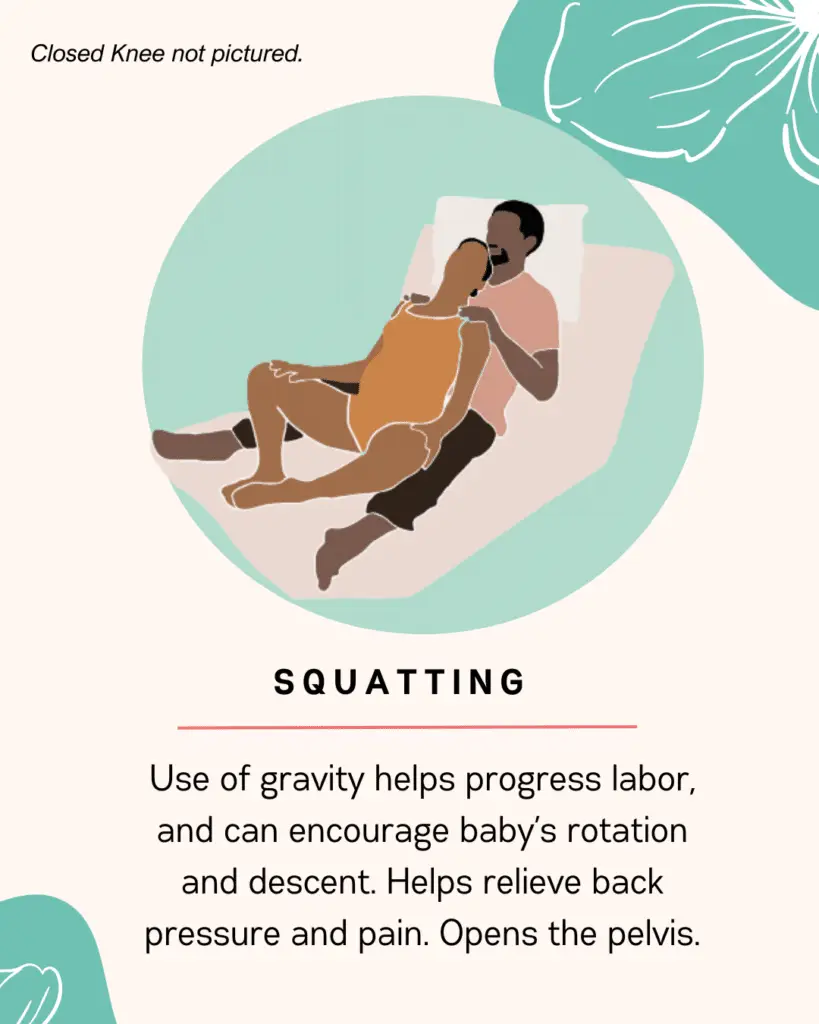
Squatting is one of the most well-known upright pushing positions, and there’s a reason for that. When you squat, you’re letting gravity do real work. Your pelvic outlet opens. Your body lines up with the natural direction baby needs to travel.

You don’t need to be unmedicated to squat. Most hospital beds have a squat bar for birth that attaches to the frame, and you can hold onto it during contractions. Birthing stools are another option. So is a support person standing in front of you for you to lean into.

A nice thing about squatting is that you can rest between contractions. Sit back, melt into the bed, then come back into the squat when the next contraction starts.

Squatting position for Labor

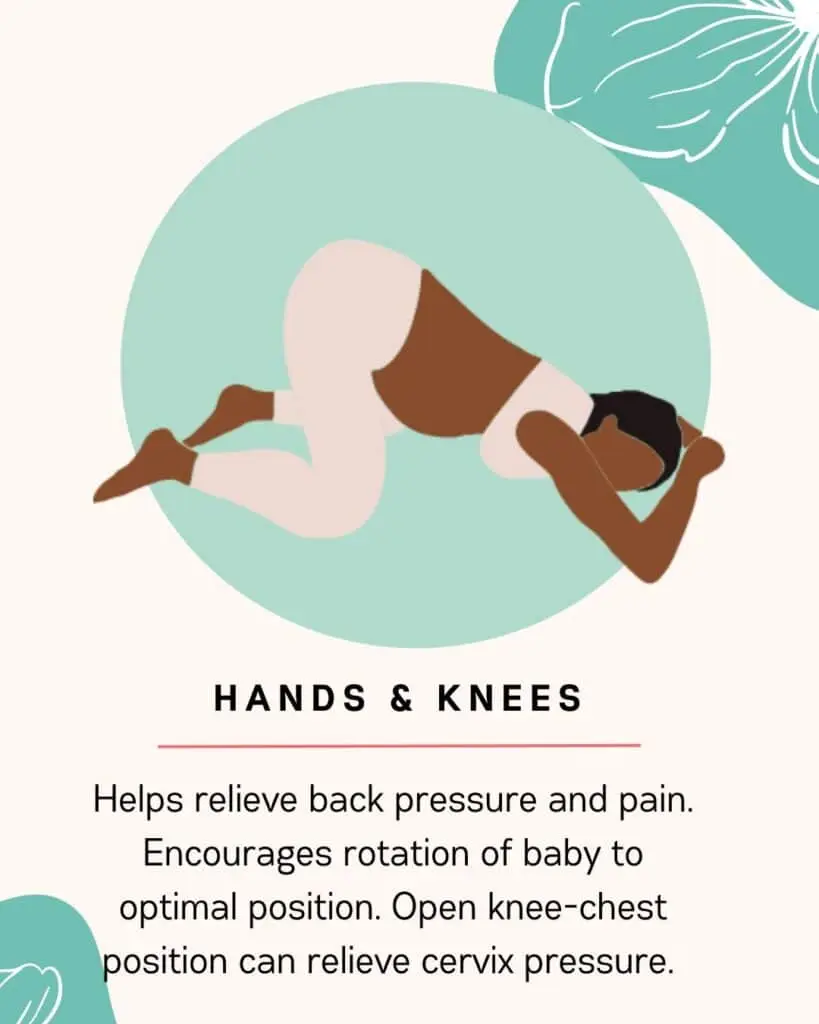
Hands and Knees Pushing Position

This one comes up often when baby’s position needs a little help. The hands and knees pushing position takes pressure off your back, opens the pelvis, and lets gravity encourage baby to rotate into a better spot.

You can do this on the bed, on the floor with a yoga mat, or leaning over a peanut ball if your wrists need a break. Even with an epidural, hands and knees is usually doable with the bed adjusted upright and a support person nearby. What we love about this position is that even when you don’t see fast progress on hands and knees, baby might be doing important rotation work that pays off in the next position you try.

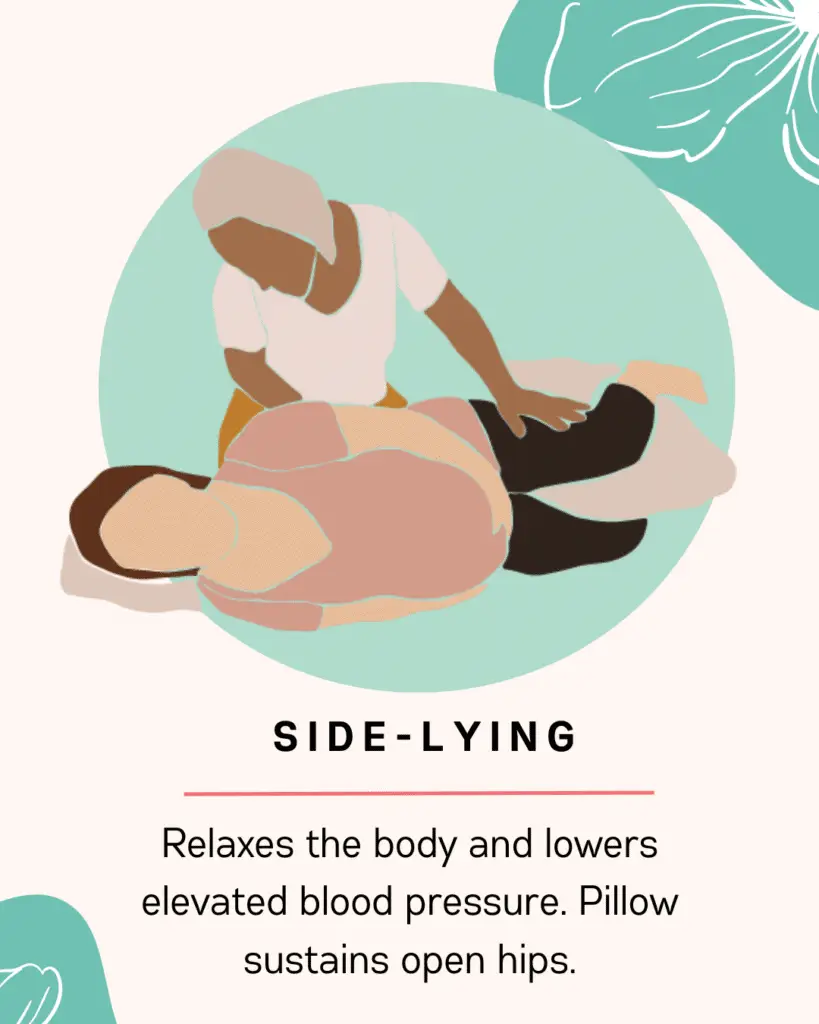
Side lying Pushing

If hands and knees feels like too much effort, or if you’re tired, sideline pushing might be the one for you. You lie on your side with your top leg supported (a stirrup, a peanut ball, or a partner can hold it), while your bottom leg stays flat on the bed.

This is one of the most popular pushing positions for moms with an epidural because it doesn’t require a lot of extra strength. But it still does important work.

  • Frees the sacrum so your tailbone can move
  • Opens the pelvis in a way back-lying can’t
  • Lets you rest fully between contractions
  • Often helps a baby that needs to rotate

You can switch sides between contractions too, which is helpful if baby is making its way around the pelvis.

Side lying position for Labor

Closed Knee Pushing

Closed knee pushing is a quieter option that doesn’t get talked about much, and it surprises a lot of people the first time they try it.

If you sit on your hands with your legs spread wide, you’ll feel your sits bones come closer together. If you put your knees together and let your ankles fall apart, you’ll feel your sits bones move further apart. That’s the outlet of your pelvis opening up.

Closed knee pushing uses this. With your knees pressed together (or close to it) and your ankles slightly apart, you’re creating more room at the outlet, which is exactly where baby is heading when it’s time to push. It works on your back, on your side, and as a finishing position when baby is close.

position for Labor
A NEXT STEP, IF YOU'RE READY

Practice these positions before labor starts.

Our birth prep course walks you through pushing positions, labor coping, partner support, and the advocacy scripts you'll want in the room. So you walk in grounded, not guessing.

Explore the course
your
Online Childbirth
Education Class

Pushing With an Epidural: You Still Have Options

A common thing we hear is that pushing with an epidural locks you into one position. That isn’t the full picture. A Cochrane review focused specifically on women with epidurals looked at upright versus lying-down positions and found that movement is still possible, and still beneficial, for many people. Here’s what’s usually available even with an epidural.

  • Sideline pushing on either side
  • Hands and knees with the bed adjusted upright
  • A modified squat using the squat bar
  • Throne position (bed inclined steeply, you sitting tall)
  • Towel under one hip for any back-lying time

The amount of movement depends on the dose, your provider’s comfort, and how your body responds. But “I got an epidural so I’m stuck on my back” is rarely the full story.

Labor Positions to Open the Pelvis

One thing that helps everything we’ve talked about make more sense. Your pelvis is not one fixed bone. It’s a structure of bones held together by ligaments, and those bones can move. There are two openings that matter during pushing: 

  • The inlet at the top of the pelvis, where baby enters
  • The outlet at the bottom of the pelvis, where baby exits

Different positions open different parts. Squatting and closed knee pushing widen the outlet. Hands and knees and forward-leaning positions can help with both. Knees together with feet apart specifically opens the outlet, which is helpful when baby is low. Knowing this means we don’t have to pick one position and stay in it. We can move with baby. When baby’s high, we open the inlet. When baby’s low, we open the outlet.

How Do I Know When to Push in Labor?

Here’s something we see often, especially in unmedicated births. The body knows.

Without meaning to, you might start leaning forward, rocking, getting onto your hands and knees, or squatting. One client looked at us mid-contraction and said, “I’m not sure why I’m doing this.” Her body went first. Her mind caught up later.

Even with an epidural, your body still gives you cues. We’ve watched moms feel that I-can’t-sit-with-this-pressure-anymore feeling right around the same time their bellies start pushing without them. Your body is talking, even when the medication is in the way. What can help here:

  • Check in with what feels productive, not just what feels comfortable
  • Notice where you feel pressure most strongly
  • Let one position settle in for two or three contractions before deciding it’s not working
  •  Trust that the urge to move means something

Why Flexibility Matters Most

If there’s one thing we want every mom to walk away with, it’s this. Birth is dynamic, not one-size-fits-all. You can have a plan. You can have your top three positions in mind. And in the moment, your body might want something different. That’s not your plan failing. That’s your body and your baby giving you new information. Flexibility shows up in two ways: 

  • Physical flexibility. Can your body settle into different positions.
  • Mental flexibility. Can you pivot when the original plan isn’t quite working.

Neither one needs to be perfect. We just want to leave room for the pivot. The best position for your birth is the one that feels right in that moment.

Frequently Asked Questions about Labor Pushing Positions

What is the most effective pushing position?

There isn’t one most effective position for everyone. Upright positions like squatting, hands and knees, and sideline tend to use gravity and open the pelvis more than back-lying does. The most effective position is usually the one that feels powerful for you in that specific moment.

Can I change pushing positions during labor?

Yes. In fact, changing positions can help baby move down and rotate, especially if pushing feels stalled. We often try a few positions in a single labor.

What pushing positions work with an epidural?

Sideline, hands and knees with the bed upright, modified squatting with a squat bar, throne position, and closed knee pushing all work with an epidural for many people. The exact options depend on your dose and how your body responds.

Will pushing on my hands and knees hurt the baby?

No. Hands and knees is a safe, common pushing position, and it often helps babies rotate into a better spot for birth.

How long is the pushing stage?

It varies. First-time moms often push for one to three hours. People who have given birth before may push for less. Position, body, and baby all play a role.

Pushing positions for labor are one of the most under-discussed parts of birth prep.

Most moms walk in knowing they’ll push, but not knowing they have options about how. That gap is something we want to keep closing.  If you want to go deeper on this, we cover it on Episode 48 of the Mom2Mom Podcast where Stephanie and Nikki walk through these positions with stories from real births. And if you’re looking for someone in the room with you who knows these positions, knows your body, and knows when to suggest the pivot, that’s where we come in as your doula.

Thank you for Being Here!

Meet How2Mom

We are experts in all things birth and postpartum. We are more than doulas - we are your centralized place for informed education and support for your journey of motherhood.

How2Mom Services

Our premier doula agency in the Twin Cities specializes in Birth Doula Services, Postpartum Doula Services, Placenta Encapsulation, and Lactation Counseling and MORE including on demand courses.

Any/all of the links in this blog may be affiliate links of which How 2 Mom, LLC receives a small commission, without any additional cost to you. Using affiliate links help us maintain our website, continue to provide for our community, and support our families, and we are forever grateful for your support! 

Leave a Reply