If someone told you early in your pregnancy that you might have a c-section, you may have wondered, do I still need a doula for that? It’s one of the most common questions we hear, and honestly, one of the most important ones to answer.
The short answer is yes. And the longer answer is what this episode is really about.
In Episode 52 of the Mom2Mom Podcast, Stephanie sits down with How2Mom client Lynley to walk through Betty’s birth story from start to finish. What began as an induction leading to c-section became one of the most calm, supported, and even joyful birth experiences either of them could imagine. By the end of this post, you’ll have a clearer picture of what a doula for a c-section actually does in the room, and why that support can change everything.
The Misconception About Doulas and Belly Birth
A lot of families assume a doula is only useful during a vaginal birth. That makes sense on the surface. Most of what we see on TV, in birth classes, and even in social media birth content centers on labor, pushing, and breathing through contractions. A c-section can feel like a completely separate category.
But here’s what we’re seeing in our work: the OR is one of the places where a familiar, informed presence matters most. The room is full of skilled people who are focused on a job. That’s exactly what you want. And at the same time, there’s often no one whose only job is to be with you.
That’s where a doula for a c-section comes in.
From Induction to C-Section: Linley's Story
Linley came into her birth with an open mind and a clear intention. After going through IVF and two egg retrievals to get pregnant, she and her husband Cole knew they couldn’t hold too tightly to a single plan. Their main goal, as Linley put it simply, was to bring home their baby alive.
They worked with Stephanie through prenatal sessions that focused on flexibility rather than a rigid birth plan. They used birth affirmation cards (How2Mom’s digital set is here) to anchor their mindset: you are safe, your baby is safe, you are strong. Not a checklist of how things needed to go. A foundation for however things unfolded.
Linley was induced, labored through the Foley balloon and cervical medication, spent time in the tub, and built a beautiful rhythm with her care team. Then, at nine and a half centimeters, Betty’s heart rate shifted, Linley’s cervix became swollen, and the decision came quickly: they needed to move to a c-section.
What happened next is a good example of why induction leading to c-section doesn’t have to feel like a loss.
Feel Confident & Prepared for Birth!
Join How 2 Mom’s childbirth education class—available online or in-person in the Twin Cities!
✔ Expert guidance from experienced birth professionals
✔ Flexible learning – self-paced online or hands-on in-person
✔ Comprehensive prep – labor stages, pain management & postpartum care
Take the stress out of birth prep and feel empowered every step of the way.
This is the part most families don’t know to ask about. A doula in the OR isn’t there to perform a medical role. They’re there to do what no one else in that room has time to do: stay with you.
Here’s what that looked like for Linley and Cole during Betty’s birth:
Slowing things down when the decision moved fast. When the care team said it was time for a c-section, Lynley had a familiar face to look at and ask, “Is this what we’re doing? What does this mean?” That moment of being able to check in mattered.
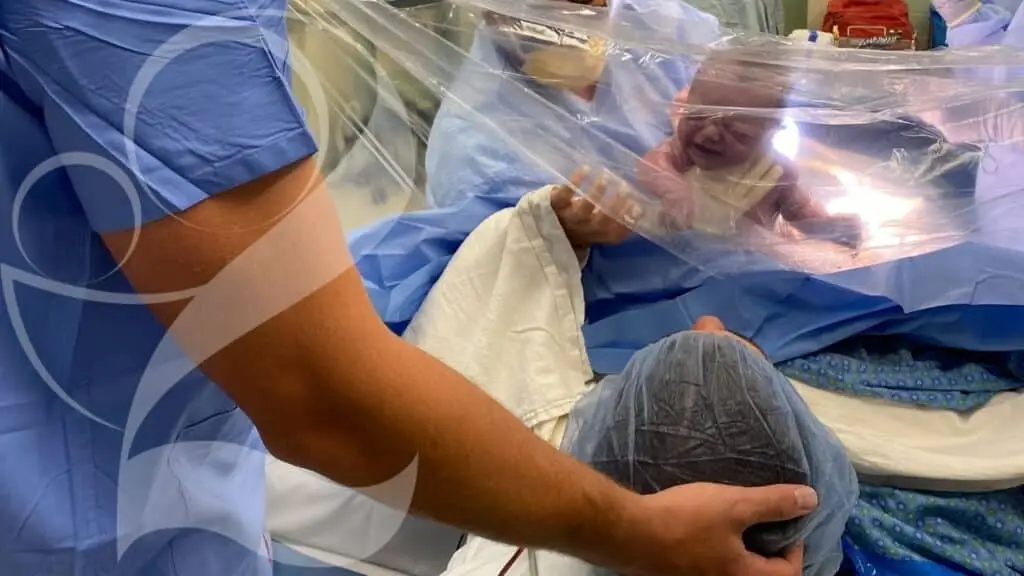
Freeing the partner to just be present. Cole didn’t have to be the informed one, the advocate, and the emotional support all at once. He could stand with Betty at the warmer and be her dad, fully, while Stephanie stayed with Linley.
Explaining the physical sensations. C-sections involve a lot of tugging and pressure. Linley had a small incision, which made delivery more difficult. Stephanie walked her through what was happening in real time so the movement didn’t feel alarming.
Supporting the nervous system. Linley got the post-surgery shakes, which is common and can feel unsettling. Stephanie massaged her jaw and shoulders, which helped her nervous system settle and brought her back into her body.
Making sure she was never alone. When Cole went to be with Betty, Stephanie stayed with Linley. No gap. No moment of being by herself in the middle of surgery.
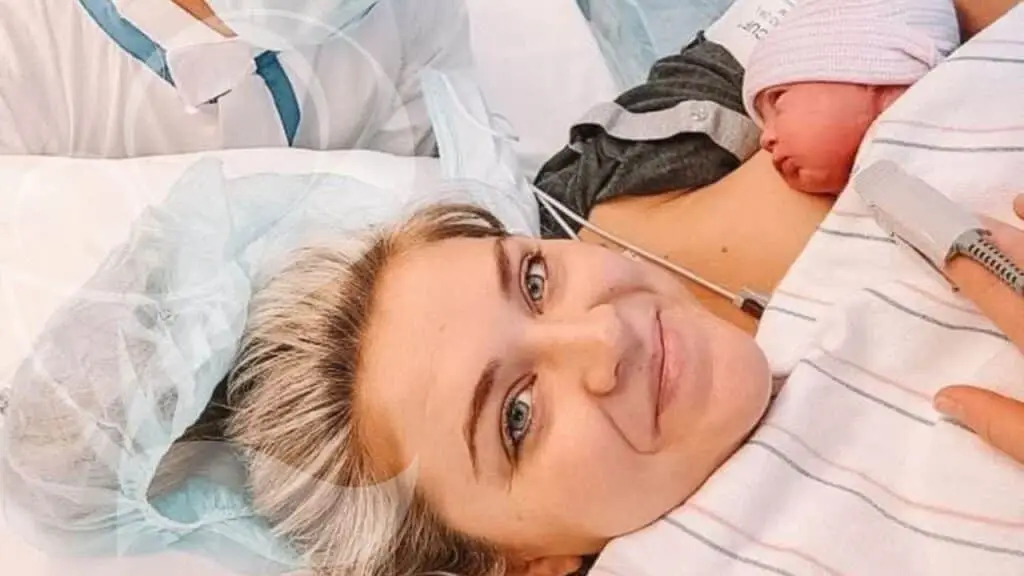
Capturing the moment. Photos and video of Betty’s arrival, cheek-to-cheek with Lynley, her first latch. Because birth is both vivid and blurry all at once, and those images let you go back and actually feel it.
What Is a Family Centered C-Section?
A family centered c-section is an approach to belly birth that prioritizes connection, not just delivery. It’s not a different medical procedure. It’s a set of options that can be requested and prepared for, most of which families don’t know to ask about.
Some of what can be part of a family centered c-section:
A clear drape, so the birthing person can watch their baby emerge
Immediate skin-to-skin in the OR, when mom and baby are both stable
Delayed cord clamping, when the birth allows for it
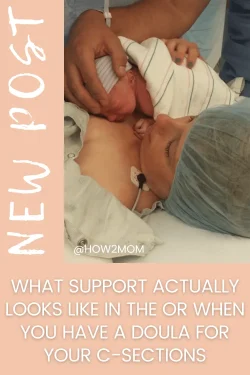
Breastfeeding or chest feeding initiation in the OR
Music, essential oils, and other calming tools brought into the space
Not every option is available in every situation. Betty had meconium present, which meant delayed cord clamping wasn’t possible. That’s the nature of birth. But knowing these options existed, and having someone in the room who knew which ones were still on the table, is part of what made Betty’s birth feel intimate and family centered even when things moved quickly.
The care team in any OR is skilled and caring. They also have a lot of jobs to do. A doula’s job is the one thing they can’t always get to: making sure the family has the context and options they deserve.
A Gentle C-Section Does Not Have to Mean a Hard Recovery From It
One of the most important things Linley said in this episode: she enjoyed her c-section. Not just that she got through it. She enjoyed it, and she would choose it again.
That doesn’t mean every belly birth feels that way, and it’s not what we’re promising here. What we are saying is that trauma and c-section are not the same thing. Assuming someone needs consoling because they had a belly birth does them a disservice. So does assuming they’re fine when they’re not.
What matters is that every birthing person gets to feel what they actually feel, without having their experience defined for them before it’s even had a chance to land.
A gentle c-section, in the truest sense, isn’t just about the surgical technique. It’s about the emotional environment. The familiar face. The person who knows your name, knows your wishes, and is paying attention to you, not just the procedure.
Research supports the connection between continuous support during birth and better emotional outcomes, regardless of birth type. A2022 review published in PubMed found that continuous labor support is associated with higher satisfaction with the birth experience. And theMayo Clinic’s overview of c-sections is a good resource if you want a clear picture of what to expect medically.
A Note on IVF Families and Birth Planning
Stephanie shared something in this episode that she’s learned from working with families who came to birth through IVF: the experience of getting pregnant can shape how you approach birth planning in ways that aren’t always accounted for.
Families who have been through retrievals, transfers, losses, and waiting often arrive at birth with a different relationship to control and uncertainty. For many, the goal of a living baby holds more weight than any particular birth path. That’s not settling. That’s wisdom that came from somewhere real.
Good doula support meets families where they are. It doesn’t push a particular birth philosophy. It holds space for what this specific family needs, which sometimes means trusting the care team completely and simply having someone alongside you for the ride.
What to Ask Before a Planned or Unplanned C-Section
Whether you’re planning a c-section from the start or it becomes the path during labor, there are things worth knowing in advance. These are conversations to have with your care team and, ideally, with your doula:
Can I request a clear drape, and what does that involve at this hospital?
What is the policy on immediate skin-to-skin in the OR if mom and baby are stable?
Can my doula be in the OR with my partner?
What should I expect to feel during the surgery, physically?
What happens if I feel nauseous or get the shakes, and who will be with me?
These aren’t questions that challenge your care team. They’re the kind of questions that help everyone in the room do their job better. If you’re looking for a doula who can help you prepare for a belly birth in the Twin Cities, you can learn more about working with us atHow2Mom’s birth doula services.
Frequently Asked Questions
Can a doula be in the operating room during a c-section?
In many hospitals, yes. Policies vary, and it’s worth confirming with your provider and hospital in advance. Some facilities allow both a partner and a doula in the OR. Others allow one support person. Knowing this before labor starts means you can plan accordingly rather than find out in the moment.
What does a doula do if the birth becomes an unplanned c-section?
This is where a doula’s role can be especially meaningful. When the path changes quickly, having someone who knows you, knows your wishes, and can help you process what’s happening in real time changes the texture of the experience. A doula can help you check in with yourself, communicate with your care team, and stay connected to what matters to you, even when the plan shifts.
Is it normal to shake after a c-section?
Yes, shaking after a c-section is common. It’s a nervous system response to the anesthesia and the physical experience of surgery. It usually affects the arms, legs, or jaw. It can feel alarming if you’re not expecting it. Knowing it’s a normal response, and having someone with you who can offer touch and reassurance in that moment, can make a real difference.
What is a family centered c-section?
A family centered c-section is a birth approach that integrates options for connection and intimacy into the surgical experience. This can include a clear drape so the birthing person can see their baby born, immediate skin-to-skin when possible, delayed cord clamping, music, and other choices that keep the family at the center of the experience. Not all options are available in every hospital or every situation, and your doula can help you know what to ask for.
Does having a doula for a c-section mean something went wrong?
No. A doula is support for your birth, whatever form it takes. Some families plan a c-section from the start and want that support from the beginning. Others, like Linley, move toward one during labor. In both cases, having someone in the room who knows you and is focused entirely on your experience is the same kind of support. The type of birth doesn’t change what you deserve.
Every Birth Deserves Support
Linley said it best at the end of the episode. She tells every pregnant person she meets to get a doula. Not because it’s a trend, and not because something might go wrong. Because having someone who knows you, advocates for you, and is there to slow things down when the room is moving fast is a gift she would choose again without hesitation.
Betty arrived in an OR that played Taylor Swift over the speakers, where the team was warm and the vibes, as Linley put it, were genuinely great. And still. Having Stephanie there made it something different. It made it a birth story Linley can’t wait to tell.
You deserve that too, whatever your birth looks like.
Listen to the full conversation with Linley onEpisode 52 of the Mom2Mom Podcast. And if you’re expecting and curious about what having a doula could look like for your birth, we’d love to connect.
We are experts in all things birth and postpartum. We are more than doulas - we are your centralized place for informed education and support for your journey of motherhood.
Our premier doula agency in the Twin Cities specializes in Birth Doula Services, Postpartum Doula Services, Placenta Encapsulation, and Lactation Counseling and MORE including on demand courses.
Any/all of the links in this blog may be affiliate links of which How 2 Mom, LLC receives a small commission, without any additional cost to you. Using affiliate links help us maintain our website, continue to provide for our community, and support our families, and we are forever grateful for your support!